Introduction
Why Sellers Onboard on More Than One Platform
Relying on a single marketplace is a concentration risk most sellers don’t think about until something goes wrong — a policy change, a sudden suspension, or a category-specific fee hike can wipe out your primary income channel overnight. Sellers who spread across two or three platforms aren’t just chasing more traffic; they’re building redundancy into their business. That said, running three onboarding processes at once isn’t free — it takes real coordination, and rushing any one of them tends to be exactly what triggers delays or rejection.
What You'll Need Before You Start (Common to All Three)
- GST registration — required for nearly all product categories on all three platforms
- PAN card (business or individual, matching your GST details)
- Bank account details with a cancelled cheque or bank statement
- Business address proof — utility bill, rent agreement, or ownership document
- Product category details — some categories need additional approval regardless of platform
Amazon, Flipkart & Meesho Onboarding — Side by Side
| Amazon | Flipkart | Meesho | |
| Typical approval time | 15-30 days | 7-15 days | 2-7 days |
| Verification strictness | Highest | Moderate-high | Lowest |
| Commission model | Category-based, plus fees | Category-based, plus fees | Zero commission (logistics fee only) |
| Category approval needed | Often, for restricted categories | Sometimes | Rarely |
| Best suited for | Branded, premium products | Fashion, electronics, mobiles | Unbranded, budget, high-volume products |
Meesho’s speed is real — most sellers we’ve onboarded go live within a week. But faster onboarding also means less platform-side vetting, which shifts more of the quality-control burden onto you as the seller, particularly around return rates and listing accuracy.
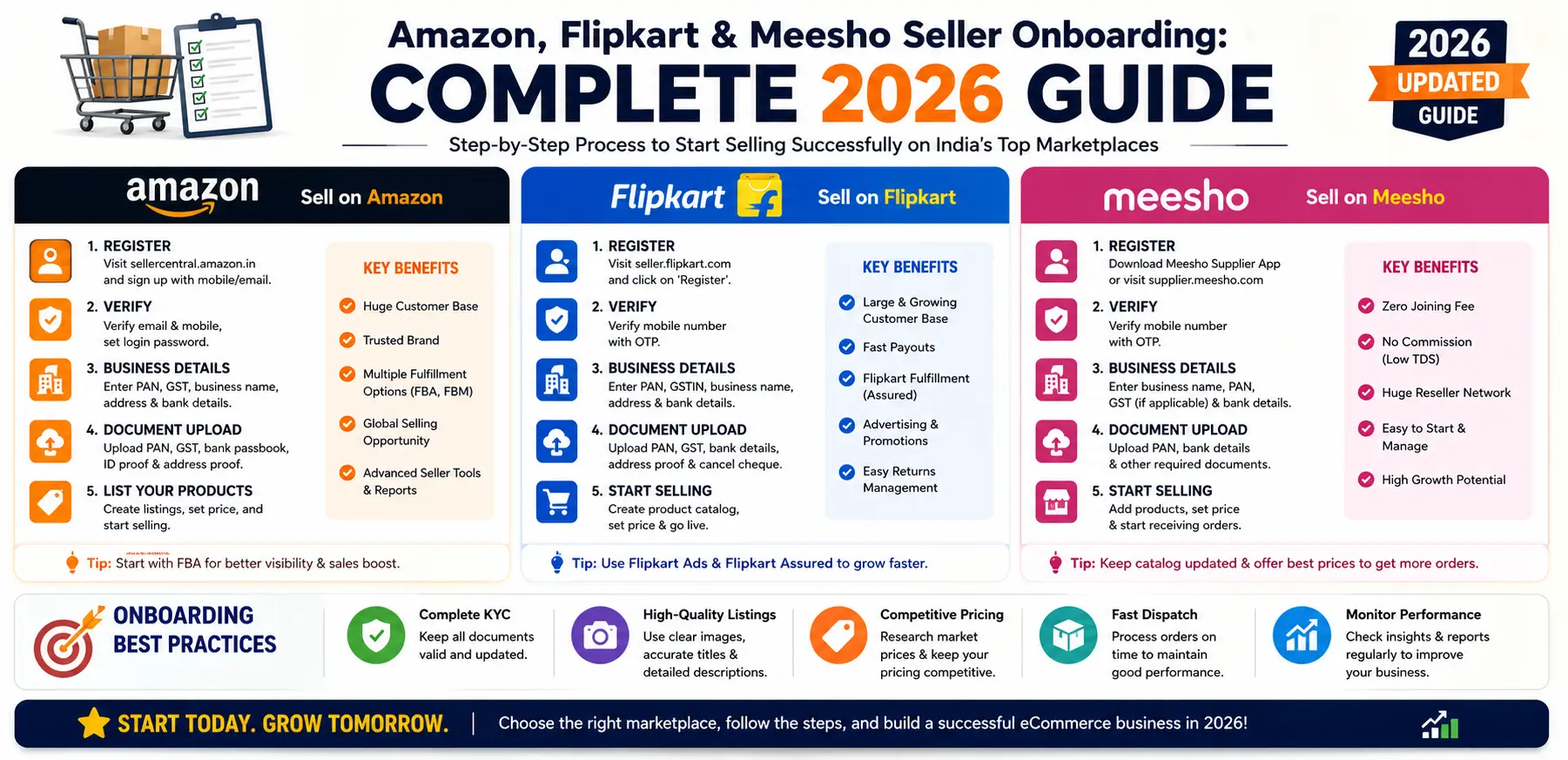
How Each Platform's Onboarding Actually Works
Why Onboarding Applications Actually Get Rejected
- Mismatched details — business name, GST, and bank account not matching exactly
- Blurry or incomplete document uploads — a surprisingly common, entirely avoidable cause
- Category restrictions — attempting to list in a category that requires approval you haven’t secured yet
- Address proof inconsistency — registered address not matching what’s on your GST certificate
- Incomplete bank verification — a cancelled cheque with details that don’t match your account name
Should You Onboard All Three at Once, or Sequence Them?
If you have the operational bandwidth, running all three in parallel makes sense — the documents overlap heavily, so there’s little extra effort in submitting to all three simultaneously. If you’re a solo seller or a small team, though, sequencing has a real advantage: start with Meesho to validate demand quickly and cheaply, use Flipkart to test a mid-tier audience, and bring Amazon in once you have some sales history and reviews to support your listings — Amazon’s stricter vetting tends to go more smoothly for sellers who already have some track record elsewhere.
Final Thoughts
If you’d rather have someone who does this daily handle the paperwork and back-and-forth for you, Sell Technical manages onboarding on Amazon, Flipkart, and Meesho — individually or all at once.
FAQs - Amazon, Flipkart & Meesho Onboarding
How long does it take to get approved on all three platforms?
Meesho is typically fastest at 2-7 days, Flipkart runs 7-15 days, and Amazon usually takes 15-30 days due to stricter verification, especially for restricted categories.
Do I need GST to sell on Meesho?
Yes, for most product categories, though Meesho’s overall documentation requirements are lighter than Amazon’s or Flipkart’s.
Can I use the same documents for all three platforms?
Mostly yes — GST, PAN, bank details, and address proof are common requirements. The details just need to match exactly across every document and every platform.
Why did my Amazon application get delayed?
Most delays come from mismatched business details across documents or missing category-specific approval — not from the core application itself.
Is it better to start with one platform or all three?
It depends on your bandwidth. Solo sellers often do better sequencing — Meesho first to validate demand, then Flipkart, then Amazon once there’s some sales history to support stricter vetting.