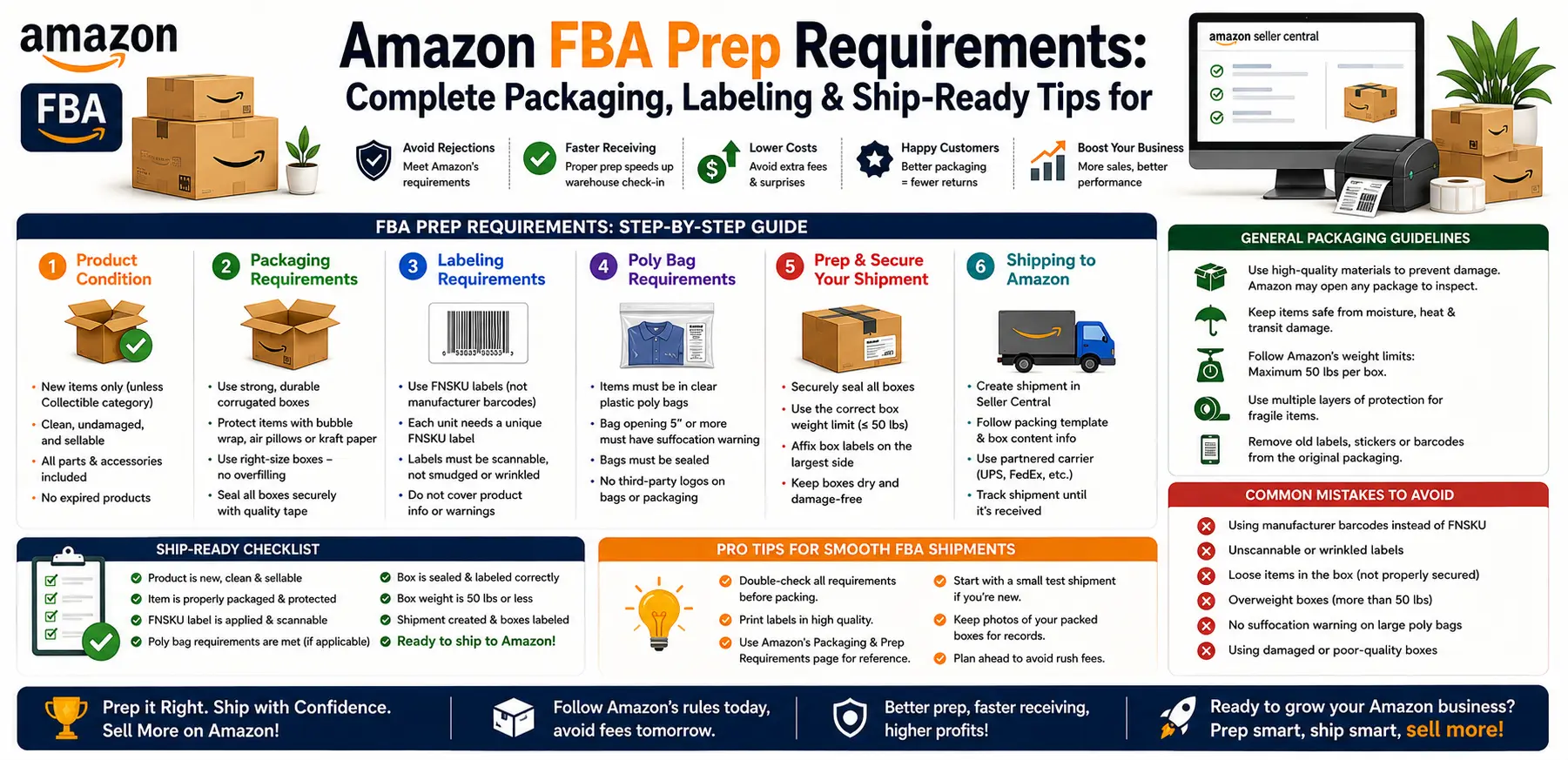
Introduction
To avoid costly inbound rejections and storage delays, every Amazon FBA seller must master the prep requirements for packaging, labeling, and shipment. One major change worth knowing upfront: Amazon discontinued its in-house FBA Prep Service in January 2026, which means sellers must now handle prep themselves or work with an external prep center — there’s no longer a “let Amazon do it” fallback option. This guide covers everything you need to send inventory that arrives ship-ready under the current rules.
Understanding Amazon's Packaging Requirements
Product Protection Standards
- Individual Oversize, Fragile, or Liquid Items: Wrap in bubble wrap or padded mailers.
- Sharp Edges: Cover with protective sleeves or edge guards.
- Sets & Bundles: Ensure all components are secured together and clearly marked.
Box Standards
- Sealable Corrugated Boxes: Use new or like-new boxes rated for your product weight.
- Maximum Weight per Box: 50 lbs (22.7 kg) to protect handlers and minimize damage.
- Box Dimensions: As of June 2025, standard cartons are capped at 36″ length × 25″ width × 25″ height. A box may exceed 36″ in length only if it contains a single oversized item that isn’t excessively larger than the item itself (a yoga mat or tripod, for example).
- Minimum Box Size: Boxes should be at least 6″ × 4″ × 1″ and weigh at least 1 lb to avoid receiving delays.
- Girth Limit: For oversize items, length + 2 × (width + height) must not exceed 165 inches for standard sortation.
Labeling Requirements & Best Practices
FNSKU Labeling
- Unique FNSKU: Every unit must bear its Amazon-issued FNSKU label covering any other barcode.
- Label Placement: Centered on a flat surface, at least ½” from edges and seams.
- Quality: Printed at 300 dpi on white, self-adhesive label stock.
Additional Label Types
- Expiration-Date Labels: For perishable goods — use ISO-8601 format (YYYY-MM-DD).
- Oversize Barcodes: For large items requiring “Amazon.com Oversize” labels.
- Team Lift Labels: Cartons weighing between 33 lb and 50 lb require a “Team Lift” warning label; cartons approaching the upper weight range may also need a “Mechanical Lift” label depending on final weight — check your current carton weight against Seller Central’s exact thresholds before shipping.
- Prep Center Labels: Since Amazon’s in-house prep service ended in January 2026, if you’re using a third-party prep center, follow their specific labeling handoff requirements rather than the old “Preparation Required” label, which no longer applies.
Ship-Ready Tips: Cartons & Pallets
Case-Packed vs. Individual Products
- Case-Packed: Multiple units of the same SKU in one inner box; each inner box receives its own FNSKU.
- Individual Products: Single units in a box; label each unit individually.
Carton Packing Guidelines
- Weight Distribution: Distribute weight evenly; place heavier items at the bottom.
- Void Fill: Use air pillows or paper to eliminate shifting.
- Sealing: Use only Amazon-approved tape (polypropylene or reinforced filament) — no bundling two boxes together with tape to make one larger box; Amazon rejects this immediately.
Pallet Requirements
- Stacking Height: Maximum of 72″ including the pallet base.
- Pallet Weight: Maximum 1,500 lbs total, including the pallet base.
- Pallet Type: Standard 40″ × 48″ wood pallets (GMA, four-way entry) in good condition — no protruding nails.
- Stretch Wrap: Use clear wrap only, minimum 3 wraps, with labels visible on the outside. Black or opaque wrap blocks Amazon’s label scanning and results in immediate rejection at receiving — this is a common, entirely avoidable mistake.
- Heavy & Bulky Exception: Single oversized items that naturally exceed standard pallet height may qualify for Amazon’s Heavy & Bulky program rather than being rejected outright.
Common Pitfalls & How to Avoid Them
| Pitfall | Solution |
| Missing or Misplaced FNSKUs | Audit each unit before packing; use a labeling jig. |
| Overweight Cartons | Use a postal scale and abide by the 50 lb limit, add Team Lift labels for 33-50 lb cartons. |
| Damaged Boxes on Arrival | Upgrade to double-wall corrugated cartons. |
| Barcode Scanning Errors | Clean and reprint labels; ensure barcode contrast. |
| Non-Compliant Tape | Switch to Amazon-approved tape types. |
| Black/Opaque Pallet Wrap | Always use clear stretch wrap so labels remain scannable. |
| Assuming Amazon Prep Service Is Available | It was discontinued in January 2026 — arrange third-party prep or self-prep instead. |
Preparing Your Shipment in Seller Central
- Create an Inbound Shipment: Go to Inventory → Manage FBA Shipments → Send/Replenish Inventory.
- Follow the Workflow: Select products, specify carton counts, and confirm box dimensions.
- Review & Approve: Amazon will generate box labels and a packing plan — download and print.
- Drop-Off or Ship: Follow Amazon’s carrier guidelines or use Partnered Carrier rates for cost savings.
What Changed Now That Amazon's Prep Service Is Gone
This is worth its own section because it affects every seller who previously relied on Amazon to handle prep in-house. Since January 2026, all prep — labeling, poly bagging, bundling, safety warnings — falls to you or a third-party prep partner. If you’re used to sending unprepped inventory and letting Amazon sort it out, that option is gone, and inventory arriving without proper prep now faces rejection or costly non-compliance fees rather than being fixed on Amazon’s end.
Final Thoughts
Getting Amazon FBA prep requirements right isn’t just about avoiding a single rejected shipment — a repeated pattern of prep errors affects your account health and future shipment approval speed. With Amazon’s in-house prep service gone as of 2026, having a reliable internal process or a trusted prep partner is no longer optional for sellers who want inventory moving smoothly into fulfillment centers.
Sell Technical offers full FBA prep support as part of our Amazon Account Management services — from label printing to pallet coordination — ensuring your shipments are 100% compliant and ship-ready even with Amazon’s prep service no longer available.
Book Your FBA Prep Consultation → or call +91 8882080135.
Frequently Asked Questions
Does Amazon still offer an in-house FBA Prep Service?
No — Amazon discontinued its in-house FBA Prep Service in January 2026. Sellers must now use a third-party prep center or handle prep themselves.
Can I combine multiple SKUs in one carton?
Yes, but only in a case-packed scenario where each unit inside is labeled individually with its own FNSKU.
What are the current Amazon FBA box dimension limits?
As of June 2025, standard cartons are capped at 36″ length × 25″ width × 25″ height, with exceptions for single oversized items. A minimum box size of 6″×4″×1″ and 1 lb also applies.
What happens if my carton weighs between 33 and 50 lbs?
It requires a “Team Lift” warning label. Cartons approaching the upper end of the weight range may need additional labeling — confirm current thresholds in Seller Central before shipping.
Why would my pallet get rejected even if it's under the weight and height limits?
Black or opaque stretch wrap is a common cause of rejection, since Amazon needs to scan carton labels through the wrap. Always use clear wrap.
What if my product dimensions change slightly after packaging?
Re-measure and update your shipment in Seller Central to reflect accurate dimensions; failure to do so can lead to fees.
Do I need special labels for hazardous materials?
Yes, hazardous or regulated items require Amazon’s Hazmat approval and proper GHS-compliant labeling.