
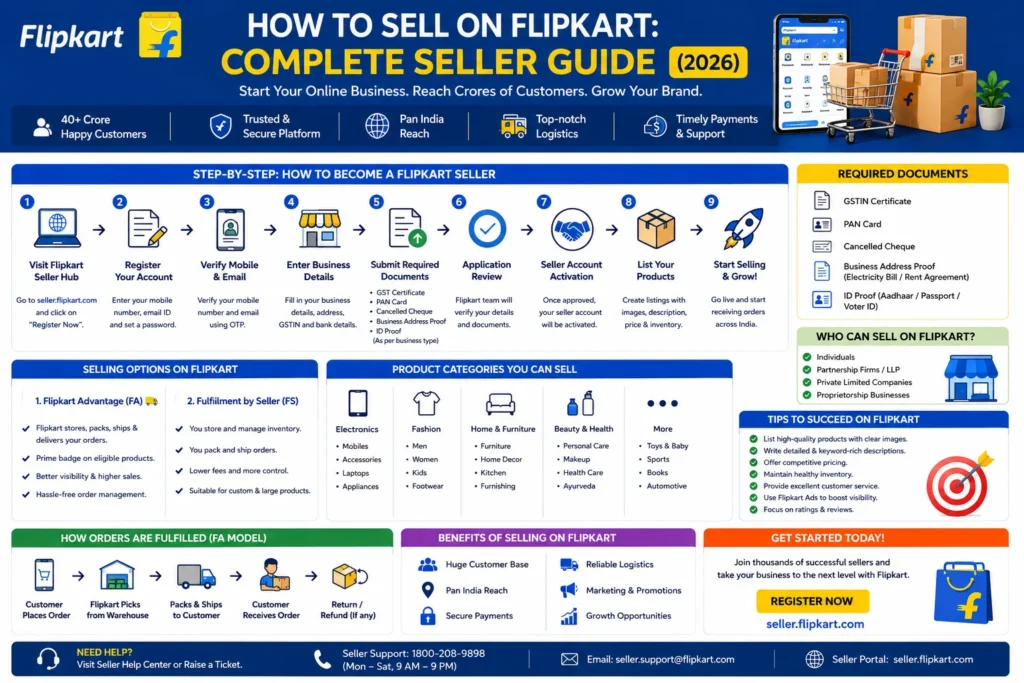
How to Successfully Sell on Flipkart in 2025: A Complete Step-by-Step Guide
Introduction Flipkart remains one of India’s largest e-commerce platforms, competing directly with Amazon for the top spot in nearly every major category. For entrepreneurs, small businesses, and established brands, how to sell on Flipkart is one of the highest-value questions in Indian e-commerce — the platform offers genuine reach, a mature logistics network, and seller-support programs that make it a viable growth channel for serious sellers, not just a side project. This guide walks through the entire process: eligibility, registration, choosing a fulfillment model, listing optimization, advertising, and the growth strategies that separate sellers who plateau from sellers who scale. Why Sell on Flipkart Flipkart’s core advantages come down to a few consistent factors: an enormous, established customer base spanning premium buyers to value-conscious shoppers, a mature logistics network (Ekart) that removes much of the fulfillment complexity smaller sellers would otherwise have to solve themselves, and growing seller-support programs aimed specifically at MSMEs and regional brands rather than just large established players. Flipkart also periodically runs seller-friendly commission structures on certain categories and price bands — check current terms directly in Seller Hub, since these programs and thresholds change over time and shouldn’t be assumed to still apply from any past announcement, including ones referenced in older guides. Eligibility and Documents Required Before registering, gather the following: GSTIN — required for most non-exempt product categories PAN card — individual or business, matching your GST registration Bank account details — for receiving payments, with a cancelled cheque or statement Business address proof — utility bill, rent agreement, or ownership document Business identity proof — depending on your structure (individual, proprietorship, partnership, company) Flipkart also supports smaller-scale and artisan sellers with somewhat adjusted documentation paths in certain categories — worth checking current eligibility criteria in Seller Hub if you’re operating at a very small scale, rather than assuming the standard business documentation path is your only option. Step-by-Step Registration Process Visit the Flipkart Seller Hub (seller.flipkart.com) and click “Start Selling.” Enter your mobile number and verify with an OTP. Provide business details — name, business type, and GSTIN. Specify your pickup address — the location Flipkart will collect inventory from. Upload required documents — PAN, GSTIN, bank details, and address proof. Select your product categories. Set up your storefront — store name, logo, and a description that actually communicates what makes your brand worth buying from, not just a generic filler paragraph. KYC and Bank Verification Once registered, complete KYC under Settings → KYC & Payments: upload GSTIN, PAN, a cancelled cheque, and any additional identity documents required for your business structure. Fill in your bank details accurately — IFSC code, account number, and account holder name matching your registered business name exactly, since mismatches here are one of the most common causes of delay. Expect approval within roughly 48-72 hours if your documents are clear and consistent; blurry or cropped scans are the most avoidable cause of extended delays. Choosing Your Fulfillment Model: FBA vs. FBM Flipkart Advantage (FBA) — you send bulk inventory to Flipkart’s warehouses, and Flipkart handles storage, packing, and delivery. This typically means faster delivery promises to customers and a stronger Buy Box position, at the cost of storage fees and less direct control over packaging presentation. Seller Fulfilled (FBM) — you handle storage, packing, and shipping yourself, either in-house or through your own logistics partner. This gives you full control over packaging and branding, with the tradeoff of managing fulfillment operations yourself, including scaling that operation during high-traffic periods. Many established sellers land on a hybrid approach — FBA for fast-moving, high-volume SKUs, and FBM for specialized, bulky, or lower-velocity products — rather than committing entirely to one model from day one. Creating Your First Listing Fill in the required fields carefully: SKU, title, MRP, selling price, stock quantity, and HSN code. Upload a clean white-background main image alongside 1-2 genuine lifestyle images that show the product in real use — verify Flipkart’s current image resolution requirements in Seller Hub before uploading in bulk, since exact specs can be updated and it’s worth confirming rather than assuming an older number still applies. For sellers managing larger catalogs, integrating your ERP or using middleware apps (tools like CedCommerce or similar Flipkart-compatible integrations) keeps inventory and order data synced automatically rather than requiring manual updates across multiple systems — a meaningful time saver once you’re managing more than a handful of SKUs. Pricing Strategy Competitive pricing on Flipkart means actively monitoring similar listings in your category, not setting a price once and leaving it static. Factor in Flipkart’s commission structure for your specific category (rates vary meaningfully by category, so check your actual applicable rate rather than assuming a flat percentage across your whole catalog) alongside your fulfillment costs when calculating your real margin — a price that looks profitable before fees can look very different afterward. Flipkart Advertising: Sponsored Ads Flipkart’s advertising tools help new listings gain visibility faster than relying on organic ranking alone: Start with auto campaigns to gather keyword and targeting data before you have enough history to run manual campaigns effectively. Refine into manual campaigns once you have performance data, targeting high-intent keywords and specific product placements directly. Use Sponsored Brands to showcase your logo, a custom headline, and multiple products together — useful for building brand recognition, not just individual SKU visibility. Set a realistic ACOS target for your category and margin structure rather than copying a generic industry benchmark — a commonly referenced starting target for new campaigns is keeping ACOS at or below 25% during the first 30 days while you’re still gathering data, though your actual sustainable target depends heavily on your specific margins. Running Promotions and Deals Configure Deals of the Day and Flash Sales under Promotions → Deals, and highlight “You Save” calculations to increase perceived urgency and value. Flipkart’s major sale events — Big Billion Days being the largest — are worth specific preparation: inventory buffer, pricing strategy, and creative should all be locked in