
How to Run a Successful Affiliate Program for Your Ecommerce Website
Reviewed by the Sell Technical team — we help D2C and ecommerce brands build growth channels beyond paid ads.
At some point, most ecommerce store owners hit the same wall: ad costs keep climbing, and every new customer is getting more expensive to acquire. An ecommerce affiliate program is one of the few growth channels where you only pay when a sale actually happens. Instead of relying solely on paid advertising, you build a network of bloggers, influencers, publishers, and content creators who promote your products in exchange for a commission. They earn when they generate sales, and you only pay after a successful conversion.
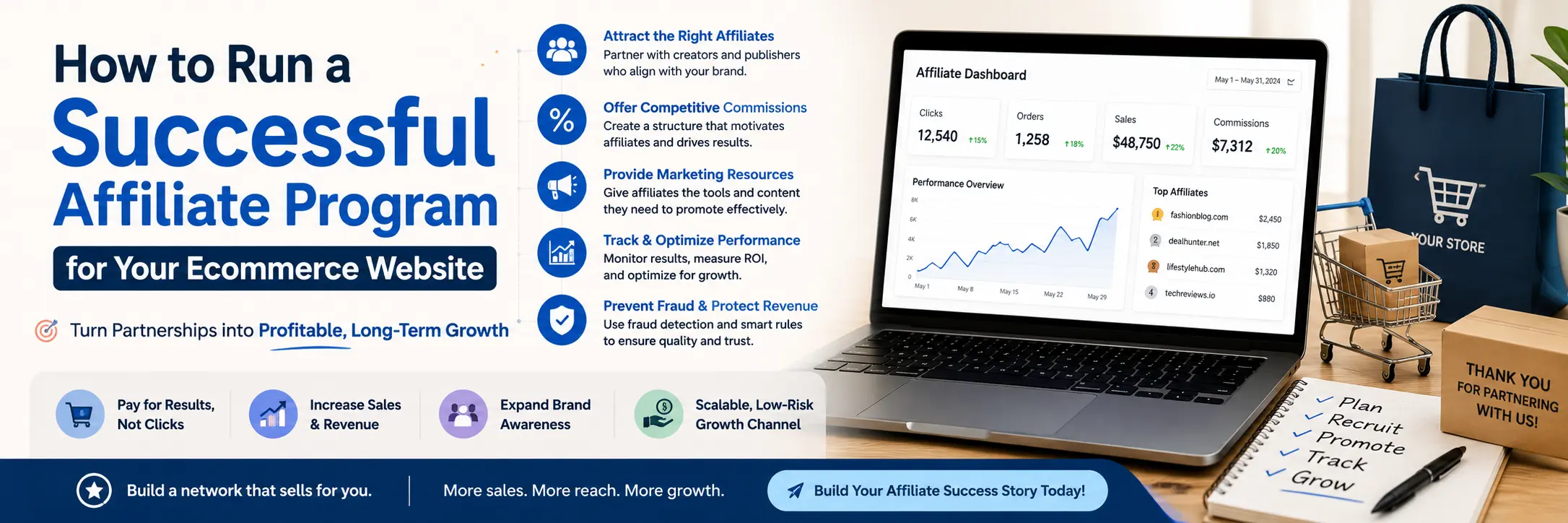
The challenge is that a poorly planned affiliate program can quickly become difficult to manage while producing disappointing results. Choosing the wrong platform, offering uncompetitive commissions, or failing to monitor affiliate quality can limit growth and even lead to fraudulent transactions. This guide explains how to create an affiliate program that delivers measurable results, covering everything from selecting the right software and designing an attractive commission structure to recruiting high-quality affiliates and implementing fraud-prevention practices that protect your business.
1. Choose the Right Affiliate Platform
Your first real decision is whether to run your program through a hosted network or self-hosted on your own site.
Hosted networks like ShareASale, CJ, or Impact come with a built-in pool of publishers already looking for products to promote, plus reliable click and sale tracking out of the box. The trade-off is cost — these networks typically charge setup fees and a cut of every transaction on top of your affiliate commissions.
Self-hosted solutions — plugins like AffiliateWP or WP Affiliate Manager for WordPress-based stores — give you full control and a lower recurring cost, but you’re responsible for recruiting affiliates yourself and monitoring for fraud, since there’s no existing network doing that vetting for you.
Whichever route you pick, prioritize platforms that offer real-time tracking dashboards, flexible commission rules (flat-rate and tiered), and auto-generated affiliate links and creative assets — manually building custom links and banners for every new affiliate gets unmanageable fast once your program grows past a handful of partners.
2. Define Your Commission Structure
Commission structure is where most new programs either attract strong affiliates or quietly fail to attract anyone worth having.
Flat-rate commissions (say, ₹200 per sale) are simple to communicate and easy for affiliates to calculate their potential earnings from. Tiered structures — 5% standard, climbing to 7% once an affiliate crosses ₹1,00,000 in referred sales — reward your top performers and give them a reason to push harder rather than promote and forget.
Cookie duration matters more than most first-time program owners expect. Thirty days is standard, but if your buying cycle is longer — think furniture, appliances, or anything people research before purchasing — a 60 to 90 day window can meaningfully boost conversions credited to your affiliates. The trade-off is more exposure to “last-click” disputes, where multiple affiliates end up claiming credit for the same eventual sale.
Set a clear payout threshold (commonly around ₹1,000) and a predictable payment schedule, monthly or bi-monthly. Affiliates talk to each other — a program with a reputation for slow or unclear payouts struggles to recruit good partners no matter how generous the commission looks on paper.
3. Recruit and Onboard Affiliates
A platform and commission plan mean nothing without people actually promoting your products, and recruitment is where most programs stall.
Start with a dedicated affiliate landing page that clearly states your commission rate, cookie duration, and what kind of partners you’re looking for, with a simple sign-up form. From there, your existing customers and social following are usually your fastest first affiliates — people who already like your product are far easier to convert into promoters than strangers.
Beyond your existing audience, niche bloggers and influencers in your product category are worth actively reaching out to rather than waiting for them to find your program. A quick search for “[your niche] blog affiliate” or a tool like BuzzSumo to find who’s already writing about products like yours can surface partners worth a direct pitch.
Once someone signs up, a slow or confusing onboarding process is one of the fastest ways to lose an affiliate before they’ve made a single sale. Send a clear welcome email with their login details, ready-to-use creative assets, and a short quick-start guide — the easier you make their first campaign, the more likely they are to actually run one.
4. Give Affiliates Creative Assets Worth Using
Affiliates promote products faster and more often when you remove the friction of having to create their own marketing material. Provide banner ads and text links in multiple sizes with several messaging variations — a plain “Shop Now” link converts differently than “Up to 50% off bestsellers.”
An auto-updated product feed or CSV lets serious affiliates pull current SKUs and pricing without asking you for updates every time your catalog changes. Ready-to-send email swipe copy that affiliates can lightly customize for their own audience also removes a real barrier — many affiliates simply won’t write original promotional copy from scratch, but they’ll gladly send something you’ve already written for them.
5. Track, Monitor, and Optimize Ongoing Performance
Once affiliates are live, the real work is watching what’s actually converting and adjusting from there. Clicks that don’t turn into sales point to either the wrong affiliate audience or creative that isn’t landing — worth investigating before assuming the affiliate simply isn’t trying. Affiliates who consistently drive a higher average order value than others are often worth moving into a higher commission tier to keep them engaged.
Simple A/B tests — a double-commission weekend, for instance — can reveal a lot about what actually motivates your specific affiliate base to push harder. And regular communication matters more than most program owners assume: a monthly newsletter highlighting top performers, new product launches, and quick optimization tips keeps your program top-of-mind for affiliates who are juggling promotions for multiple brands at once.
6. Prevent Fraud and Protect Your Brand
Affiliate fraud is rarely dramatic — it’s usually small, quiet abuse that adds up over time if nobody’s watching. Basic protections like CAPTCHA on your affiliate sign-up form and IP-based monitoring on click activity catch a meaningful share of low-effort fraud before it costs you real money.
Clear brand guidelines matter too — spell out acceptable logo usage and explicitly prohibit practices like coupon-code arbitrage or bidding on your own brand terms in paid search without approval, since both quietly cannibalize sales you’d have made anyway without paying a commission on them.
Make a habit of reviewing payout requests and your highest-volume affiliates periodically. A sudden spike in an affiliate’s sales, especially with an unusually high refund or cancellation rate attached, is worth a closer look before the next payout goes out.
Getting Started
Launching an ecommerce affiliate program doesn’t require a huge upfront investment, but it does require a clear plan before you open sign-ups:
- Choose and configure your affiliate platform or plugin
- Define and publish your commission structure and recruitment page
- Actively recruit your first affiliates instead of waiting for them to find you
- Provide creative assets, track performance closely, and keep optimizing based on what the data actually shows
Done well, an affiliate program becomes one of the more cost-efficient growth channels available — you’re only paying for results that already happened, not for the possibility of one.