
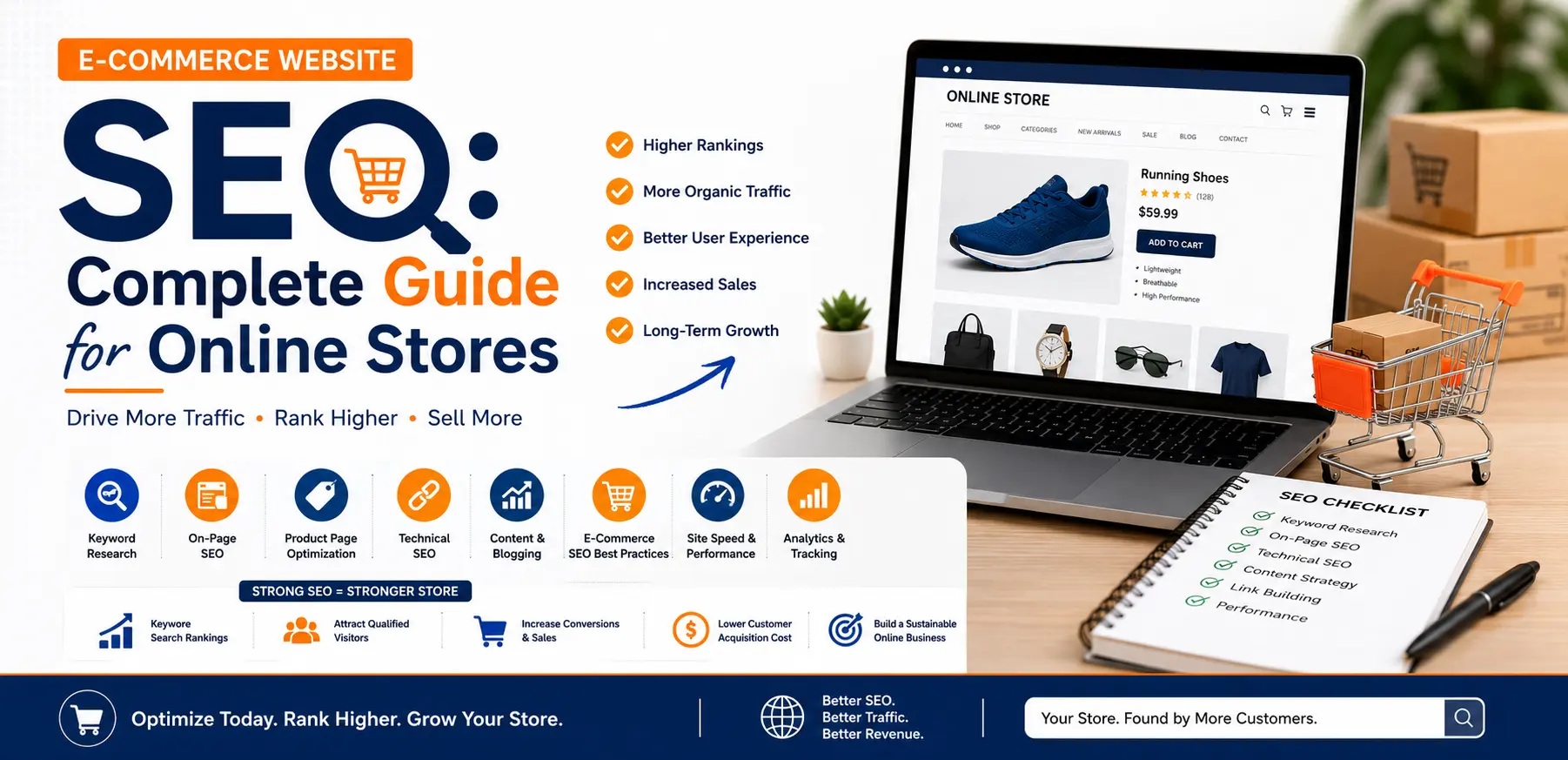
E-Commerce Website SEO: Complete Guide for Online Stores
Introduction
Launching an ecommerce affiliate program doesn’t require a huge upfront investment, but it does require a clear plan before you open sign-ups:
- Choose and configure your affiliate platform or plugin
- Define and publish your commission structure and recruitment page
- Actively recruit your first affiliates instead of waiting for them to find you
- Provide creative assets, track performance closely, and keep optimizing based on what the data actually shows
Done well, an affiliate program becomes one of the more cost-efficient growth channels available — you’re only paying for results that already happened, not for the possibility of one.
What Is E-Commerce SEO?
E-commerce SEO is the process of optimizing an online store so its category pages, product pages, and supporting content rank for relevant search terms. Unlike a blog or a service-based website, e-commerce SEO leans heavily on product discovery, category-level rankings, transactional search intent, technical site performance, and conversion optimization once the traffic actually arrives.
The goal isn’t traffic for its own sake — it’s traffic that converts.
Why SEO Is Critical for E-Commerce Websites
Paid ads stop the moment you stop spending. SEO, done properly, compounds — a product page ranking well in month three tends to keep ranking (and improving) in month twelve, without additional spend to maintain that position.
The real benefits show up over time: higher organic product visibility, a lower blended customer acquisition cost as organic traffic grows alongside paid, sustained traffic growth that doesn’t disappear when budgets tighten, stronger trust and brand authority from ranking well for the terms your customers actually search, and better conversion rates since organic visitors typically arrive with clearer buying intent than cold ad traffic.
Most online stores don’t fail at SEO because SEO doesn’t work — they fail because it’s implemented piecemeal, usually as an afterthought bolted onto a site that wasn’t built with it in mind.
How E-Commerce SEO Differs from Regular Website SEO
| Regular SEO | E-Commerce SEO |
|---|---|
| Blog-focused | Product & category-focused |
| Few pages | Hundreds or thousands of URLs |
| Informational intent | Transactional intent |
| Simple structure | Complex site architecture |
That extra complexity is exactly why planning and technical execution matter more here than on a typical content site — a mistake that costs one blog post some rankings can cost an e-commerce store an entire category’s worth of visibility if it’s baked into the site’s structure.
Keyword Research for E-Commerce Websites
Keyword research is the foundation everything else gets built on, and for e-commerce it splits into three distinct types that each map to a different kind of page.
Product keywords — terms like “buy running shoes online” or “wireless earbuds price” — carry direct purchase intent and convert fastest. These belong on individual product pages.
Category keywords — broader terms like “men’s running shoes” or “wireless audio accessories” — bring higher search volume and belong on your category pages, where they can capture demand across your whole product range rather than a single SKU.
Informational keywords — searches like “best running shoes for beginners” or “how to choose earbuds” — don’t convert immediately, but they build topical authority and funnel visitors toward your product pages once they’re ready to buy.
The mistake we see most often is mapping several keyword types onto the same page instead of matching each type to the page built to capture it — a product page trying to rank for a broad category term usually loses to a dedicated category page every time.
E-Commerce Website Structure and SEO
A clean structure helps both users and search engines find what they’re looking for without friction. Keep important pages reachable within three clicks from the homepage, use clean and readable URLs, avoid duplicate category paths that split ranking signals across near-identical pages, and use breadcrumb navigation so both Google and your visitors always know where they are in the catalog.
A simple hierarchy works best: Home leads to Category, Category leads to Sub-category, and Sub-category leads to the individual Product page. Poor structure — deep nesting, orphaned pages, duplicate paths to the same product — is one of the more common reasons a technically sound store still struggles to rank.
On-Page SEO for Product Pages
Product pages are where sales actually happen, and where SEO mistakes are most common. Write unique product titles instead of copying supplier descriptions word-for-word (duplicate content across dozens of competing sellers using the same manufacturer copy is one of the fastest ways to get outranked). Pair that with SEO-friendly meta titles and descriptions, genuinely detailed product descriptions rather than two or three throwaway lines, properly optimized images with descriptive alt text, internal links back to relevant category pages, and visible user reviews and ratings, which help both SEO and buyer trust.
Thin or duplicate product pages are consistently one of the biggest ranking killers we see on new client stores.
On-Page SEO for Category Pages
Category pages often outrank individual products for broader search terms, which makes them worth just as much optimization attention. Add 300 to 600 words of genuinely descriptive content rather than a bare product grid, use your H1 and H2 headings with natural keyword variations, link internally to your top-performing products, optimize filter URLs so they don’t create duplicate indexable pages, and use SEO-friendly pagination rather than infinite scroll that Google can’t easily crawl.
Well-optimized category pages tend to drive the most scalable, compounding traffic of any page type on an e-commerce site.
Technical SEO for E-Commerce Websites
Technical SEO isn’t optional groundwork you can skip if the content is good enough — it’s the foundation everything else sits on. Fast page load speed, mobile-friendly design, secure HTTPS, proper canonical tags to prevent duplicate content issues, a crawl budget that isn’t wasted on filter and sort-parameter URLs, an XML sitemap covering both products and categories, and structured data (schema markup) for products and reviews all matter here.
If the technical layer is weak, even excellent content struggles to rank — Google simply can’t crawl and index what it can’t efficiently reach.
Mobile SEO for Online Stores
Most e-commerce traffic today comes from mobile, and Google indexes your mobile version first, not your desktop version — so mobile experience isn’t a secondary concern, it’s the primary one. That means responsive design, fast mobile load times, easy navigation and filtering on a small screen, thumb-friendly buttons, and a genuinely simplified checkout flow that doesn’t require excessive zooming or scrolling to complete.
Content Strategy for E-Commerce SEO
Blog content still has a place in e-commerce SEO, but only when it’s tied directly back to your products rather than existing in isolation. Buying guides, product comparisons, “best of” roundups, use-case articles, and industry-specific content all work well — as long as each piece links naturally into the products it’s discussing, turning informational traffic into a path toward a purchase rather than a dead end.
Common E-Commerce SEO Mistakes
A handful of mistakes account for most of the ranking problems we see: duplicate product descriptions copied from suppliers, filter and sort URLs getting indexed and competing with your real category pages, ignored site speed, little to no internal linking between related products and categories, a poor mobile experience, no dedicated SEO strategy for category pages specifically, and relying entirely on paid ads with no organic strategy as a backup. Fixing even a few of these can produce a noticeable ranking improvement on its own.
How Long Does E-Commerce SEO Take to Show Results?
SEO isn’t instant, but it’s fairly predictable when the fundamentals are handled correctly. In our experience managing SEO alongside marketplace accounts for clients, the general pattern looks like this: the first one to two months go toward technical and structural fixes, months three to four typically show the first real keyword movement, and consistent, compounding traffic and sales growth tends to show up from month six onward.
These timelines shift depending on your competition and how much technical debt the site is starting with — a brand-new store in a low-competition niche can move faster, while an established site correcting years of structural issues will usually take longer before the fixes fully take effect.
Should You Hire an E-Commerce SEO Expert?
If your store has hundreds of products, spans multiple categories, carries unresolved technical issues, or is getting traffic that isn’t converting the way it should, bringing in dedicated SEO expertise is usually worth it. SEO mistakes in e-commerce tend to be expensive and slow to unwind later — a poorly planned site structure or years of duplicate content is a lot more work to fix retroactively than to avoid from the start.
Build SEO Into Your Website From Day One
SEO works best when it’s part of the initial build, not something bolted on after launch. If you’re building or redesigning an online store, SEO decisions — URL structure, category architecture, page speed — need to be part of the architecture itself, not an afterthought once the site is already live.
A store built this way tends to rank faster, convert better, scale more smoothly as the catalog grows, and reduce how much you need to lean on paid ads to hit revenue targets.